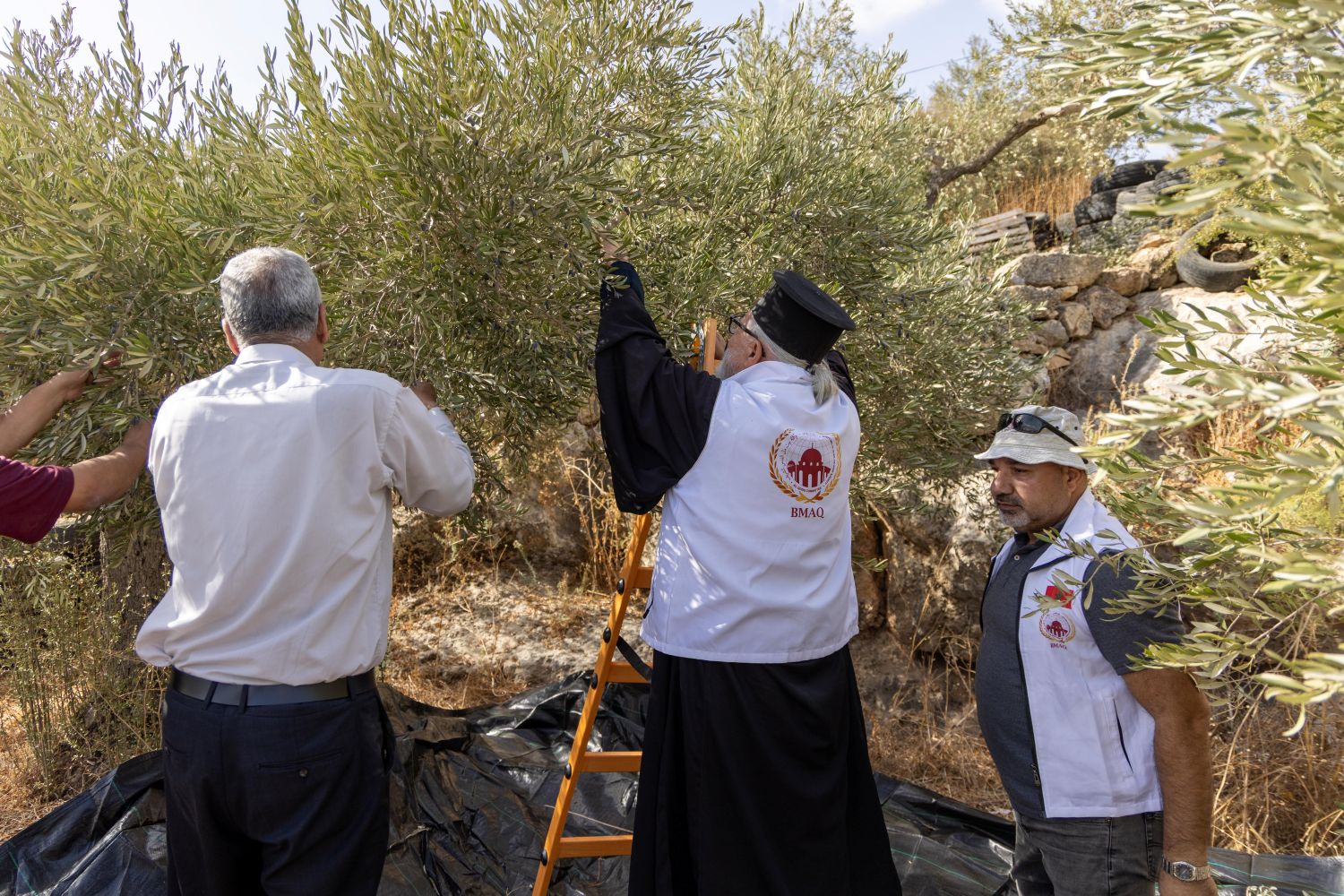
Jerusalem – The Bayt Mal Al-Quds Asharif Agency (BMAQ), operating under the Al-Quds Committee chaired by His Majesty King Mohammed VI, launched the 2026 edition of its “Awna” campaign on Tuesday in Al-Ram, north of Jerusalem, to support Palestinian farmers during the olive harvest season. The campaign is funded by contributions from the Moroccan Association for the Support of Reconstruction in Palestine and the Municipality of Fez.
The campaign is expected to reach around 2,250 farmers across 20 locations in the Jerusalem Governorate, covering 16 agricultural access gates. It also provides harvesting equipment and supplies to help farmers gather their crops more efficiently, preserve produce quality and safeguard their harvest.
This year’s campaign comes amid mounting challenges for Palestinian farmers, particularly olive growers, who face restrictions on accessing their land and repeated attacks by settlers protected by Israeli occupation forces.
BMAQ noted that the “Awna” campaign forms part of its broader efforts, in line with the directives of His Majesty King Mohammed VI, Chairman of the Al-Quds Committee, to support Jerusalemites and strengthen their resilience, particularly by helping small-scale farmers sustain their agricultural activities and protect their crops. The campaign reflects the Agency’s commitment to mobilising available resources through practical initiatives that address the needs of the Holy City and its inhabitants and support the local agricultural sector.
Faiha Najm, Director-General of Agriculture in the Jerusalem Governorate, underscored the campaign’s importance this year amid an unprecedented escalation in attacks during the olive harvest season. She reported that more than 87 farmers had been attacked in Jaba’, Beit ‘Anan, Silwan and Abu Dis, while over 70 farmers in Mikhmas were struggling to access their land to harvest their olives.
For the seventh consecutive year, BMAQ has provided farmers with olive-harvesting equipment, including battery-powered mechanical harvesters, nets and bags for collecting and transporting the crop. The equipment speeds up harvesting, reduces the time olives are left unattended in the fields and helps minimise the risk of theft.
Najm noted that the equipment provided, including harvesters, ladders, nets and combs, would help farmers carry out the olive harvest more efficiently. She commended BMAQ’s ongoing support and voiced hope that it would continue, given its vital role in strengthening farmers’ resilience.
Meanwhile, Tahani Al-Lawzi, adviser to the Governor of Jerusalem, explained that the “Awna” campaign covers the entire governorate, including areas inside and outside the separation wall. The initiative seeks to support Jerusalem’s farmers, strengthen their resilience and attachment to their land, and preserve the olive tree as a symbol of Palestinian identity and heritage and a vital source of livelihood for farming families.
On behalf of Jerusalem Governor Adnan Ghaith, Al-Lawzi expressed her gratitude to His Majesty King Mohammed VI, Chairman of the Al-Quds Committee, for his support for the campaign. She also highlighted the Moroccan-Palestinian partnership in supporting farmers and Jerusalemites and helping them remain steadfast on their land.
Muwafaq Al-Khatib, head of the northwestern Jerusalem unit at the Jerusalem Governorate, said the equipment helps farmers harvest their olives more efficiently amid continued attacks on olive trees. He expressed his gratitude to the Kingdom of Morocco, its government and people, and BMAQ for their ongoing support.
Hamza Oweisat, a representative of Al-Sawahreh Al-Sharqiyah Municipality, said the campaign came at a critical time, providing Palestinian farmers with the tools and supplies they need for the olive harvest. He thanked BMAQ, the campaign’s main supporter, for its continued solidarity with farmers amid these challenging circumstances.
Medhat Al-Jamal, Mayor of Beit Surik, praised the cooperation between the Jerusalem Governorate and BMAQ in supporting farmers across the governorate, particularly in northwestern Jerusalem. He said the equipment would help farmers tend their olive trees and remain connected to their land.
He also urged that support extend beyond harvesting equipment to encompass agricultural development and better practices for cultivating and maintaining olive trees.
Abdel Halim Hamza, a farmer from Qalandiya al-Balad and a beneficiary of the “Awna” campaign, expressed his gratitude to the Kingdom of Morocco and BMAQ for their support. He said the equipment would help him harvest his olives and complete the season’s work.
The “Awna” campaign complements BMAQ’s wider efforts to support Palestinian farmers, including the “Sumoud” (Resilience) project, launched in January 2026 to benefit 250 farmers, and the Field Schools project, launched in November 2025 to build farmers’ skills through hands-on agricultural training.